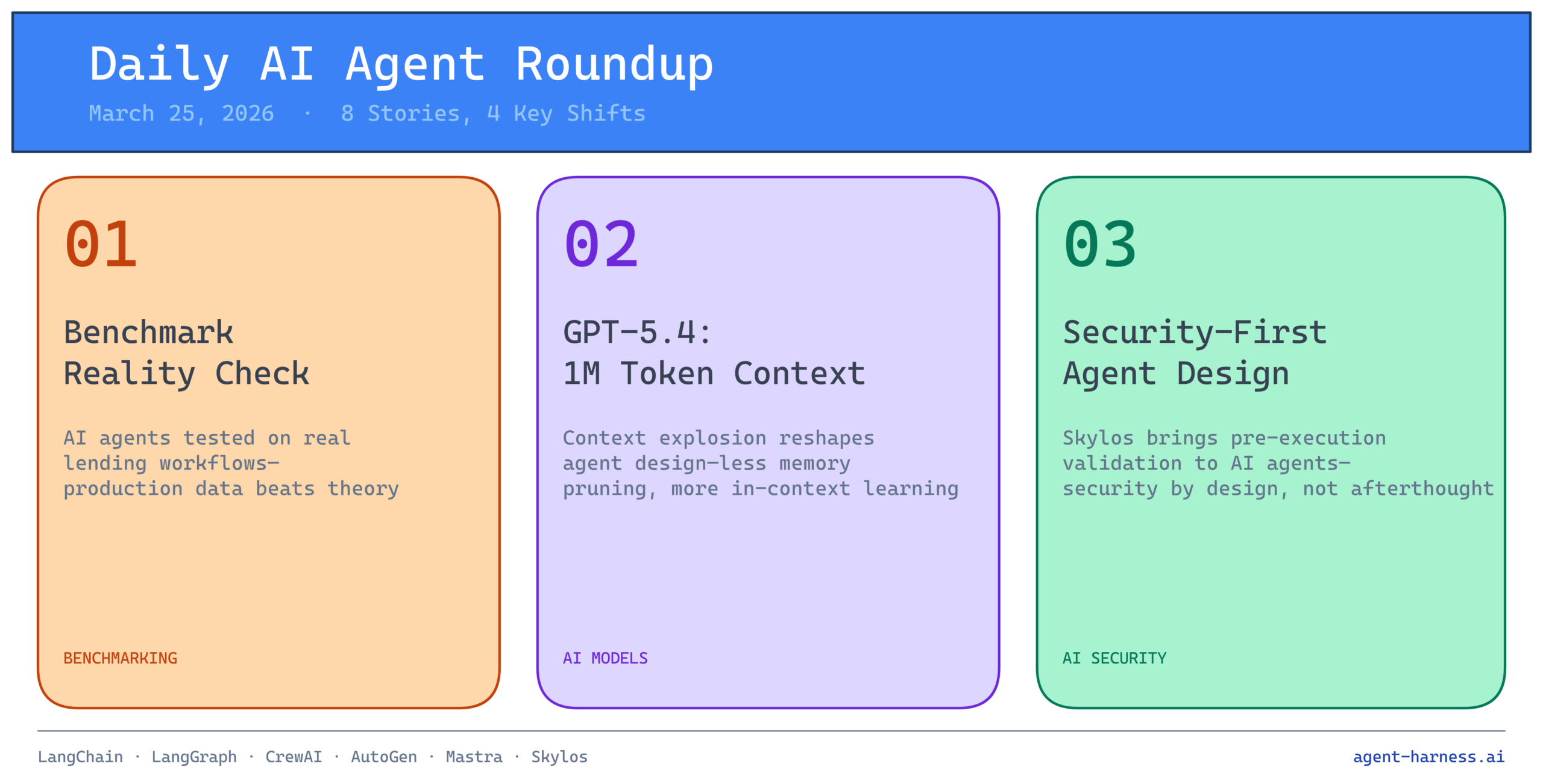
The AI agent ecosystem continues its rapid evolution, with significant developments this week spanning framework maturity, real-world performance validation, security-first tooling, and a new generation of expanded context models. Today’s roundup covers critical insights for anyone evaluating, building, or deploying agent orchestration systems at scale.
1. LangChain’s Continued Dominance in Agent Engineering
LangChain’s prominence in agent engineering underscores its importance in the evolving landscape of AI agent development, maintaining its position as the de facto standard for production agent pipelines. The framework’s flexibility in supporting multiple LLM providers, memory backends, and tool integrations continues to make it the most adopted choice for enterprise deployments. However, this ubiquity also highlights a critical trade-off: raw flexibility often comes at the cost of opinionated agent patterns that newer frameworks (like LangGraph) are beginning to standardize.
Framework Analyst Take: LangChain remains the safe choice for teams building customized agent solutions, but its architectural breadth means you’re responsible for implementing solid patterns yourself. If your team lacks strong engineering discipline around agent state management and tool execution, consider frameworks that enforce stricter patterns upfront.
2. Benchmarked AI Agents on Real Lending Workflows
A community-driven performance study of AI agents deployed in lending workflows provides crucial real-world data on agent reliability, accuracy, and latency in financial services applications. These benchmarks reveal which frameworks and tool combinations actually perform under production constraints—including regulatory auditing requirements and high-stakes decision verification. This kind of domain-specific validation is increasingly essential as enterprises move beyond chatbot use cases into autonomous decision-making.
Framework Analyst Take: Lending is one of the most scrutinized domains for AI deployment, making this benchmark particularly valuable for understanding agent stability requirements. If you’re deploying agents in compliance-heavy verticals (finance, healthcare, legal), real-world lending benchmarks like this should directly inform your framework selection and orchestration patterns.
3. Skylos: AI Security Meets Agent Development
Skylos introduces a security-first approach to agent development by combining static analysis with locally-deployed LLM agents, addressing growing concerns about prompt injection, unauthorized tool execution, and data exposure in agent systems. Rather than relying solely on model guardrails, Skylos validates agent behavior before execution—a critical distinction for regulated environments. As AI security becomes a primary concern, frameworks that build security into the agent orchestration layer (rather than bolting it on afterward) will differentiate themselves in enterprise deployments.
Framework Analyst Take: Skylos represents an important emerging pattern: security-by-design in agent frameworks rather than security-as-an-afterthought. If your organization has strict compliance or data governance requirements, evaluate whether your chosen framework can enforce similar pre-execution validation patterns. LangChain’s extensibility allows custom security layers, but dedicated frameworks like Skylos bake this in.
4. Comprehensive Comparison: 25+ AI Agent Frameworks in 2026
The AI agent framework landscape is fragmenting productively—with LangChain, LangGraph, CrewAI, AutoGen, Mastra, and 20+ emerging frameworks each optimizing for different use cases and team structures. This comprehensive comparison highlights a critical insight: there’s no universal “best” framework. Instead, the decision hinges on your specific constraints: team size, domain complexity, operational maturity, and required guardrails. Frameworks optimized for agentic workflows (CrewAI, AutoGen) differ fundamentally from infrastructure-focused choices (LangChain) or emerging specialized tools (Mastra for multi-agent enterprise patterns).
Framework Analyst Take: If you’re still evaluating frameworks in 2026, the decision should be driven by three factors: (1) Does it enforce the agent patterns your team will actually maintain? (2) Can it integrate with your existing observability and security infrastructure? (3) Does the vendor/community align with your roadmap’s multi-year vision? Framework comparisons are useful anchors, but implementation reality beats theoretical rankings every time.
5. The Rise of the Deep Agent: Understanding Coding Agents
A critical distinction is emerging between basic LLM workflows and “deep agents”—sophisticated systems that maintain state, iterate on feedback, and reliably produce production-grade code rather than documentation-ready snippets. Coding agents represent one of the most demanding use cases for agent frameworks, requiring robust error handling, intelligent retry logic, and precise tool execution semantics. Understanding this distinction between shallow prompt-chaining and deep agent capabilities is essential for teams evaluating AI coding tools and deciding whether to build or buy agent infrastructure.
Framework Analyst Take: Coding agents are a useful stress test for evaluating any framework’s maturity. If an agent framework can reliably handle 50-line code generation tasks with dependency resolution and testing, it can likely handle most enterprise workflows. This is where frameworks like LangGraph’s typed agents shine—they enforce the state management discipline that coding agents demand.
6-8. GPT-5.4 Release: 1 Million Token Context Window
OpenAI’s release of GPT-5.4 with a 1 million token context window is a significant development in AI agent capabilities, fundamentally expanding what agent systems can accomplish in a single request. Traditional agent frameworks were designed around context window constraints that required careful tool selection, memory pruning, and multi-step planning. With massive context windows, some existing patterns become obsolete (you may no longer need as aggressive memory management), while new patterns become viable (storing entire conversation histories, large codebases, or complex documents directly in context). The introduction of Pro Mode suggests OpenAI is also optimizing inference for longer, more complex agent reasoning chains.
Related Coverage: 5 Crazy AI Updates This Week and 5 Crazy AI Updates (Alternative) both highlight the broader AI acceleration this week, with context expansion being the most directly relevant to agent framework planning.
Framework Analyst Take: The 1M context window fundamentally shifts agent design trade-offs. Your framework of choice should now be evaluated not just on tool execution efficiency, but on its ability to leverage massive context windows effectively. This could mean:
– Simpler memory management (less need for aggressive pruning)
– More sophisticated in-context learning patterns
– Ability to work with entire domain knowledge bases in a single agent session
– Potentially reduced latency for complex workflows (fewer round-trips to the model)
However, cost implications are substantial—ensure your framework’s observability gives you visibility into token consumption across agent runs.
Weekly Synthesis: Framework Selection in the 1M Token Era
This week’s developments converge on a single insight: the agent framework landscape is maturing rapidly, and framework selection is increasingly about operational patterns rather than raw capability gaps.
What’s changing:
– Benchmarking is normalizing: Real-world performance data (like the lending workflow study) is becoming the primary evaluation method, displacing theoretical comparisons.
– Security-first tooling is table stakes: Frameworks without built-in security validation layers will struggle in regulated verticals.
– Context explosion is reshaping patterns: The 1M token window requires frameworks that can help you leverage—not fight—massive context availability.
– Specialization is accelerating: LangChain remains flexible enough for custom needs, but purpose-built frameworks (CrewAI for teams, Mastra for enterprise patterns, Skylos for security) are becoming the preferred choice for specific use cases.
The practical implication: If you’re selecting a framework today, run these three tests:
- Pattern Test: Can the framework enforce the agent patterns your team will actually maintain six months from now?
- Observability Test: Does it provide visibility into token consumption, tool execution reliability, and agent reasoning steps?
- Context Test: Is it optimized to help you effectively use massive context windows, or does it still assume you need to fight context constraints?
The agent framework that wins your evaluation isn’t necessarily the most feature-complete—it’s the one that makes it easiest for your team to build, deploy, and maintain reliable agents in production.
Alex Rivera is a framework analyst at agent-harness.ai, focusing on practical evaluation of AI agent orchestration tools through benchmarks, real-world case studies, and hands-on framework comparisons.