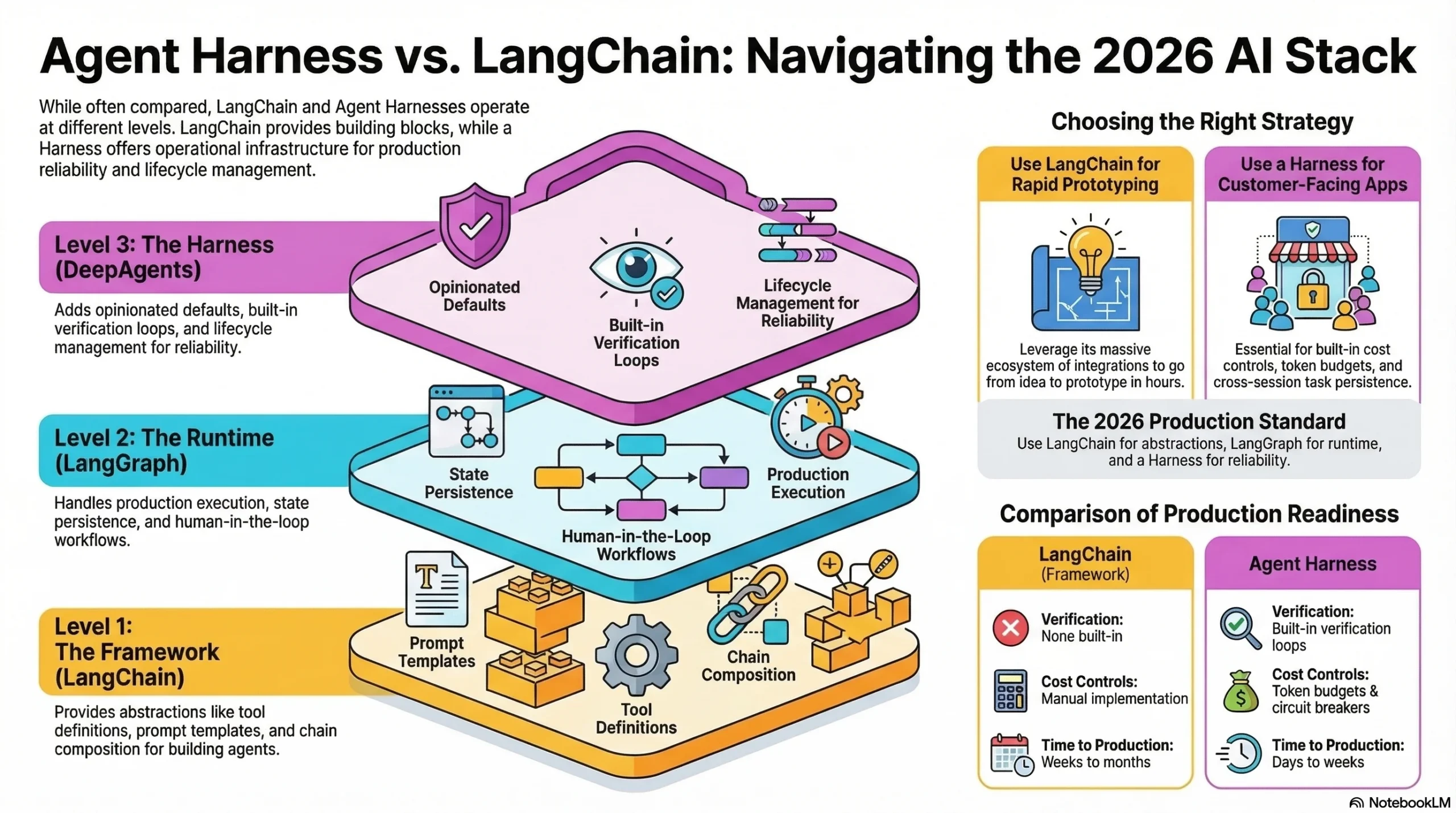
LangChain’s own team published a blog post titled “Agent Frameworks, Runtimes, and Harnesses – oh my!” that explains the distinction. Frameworks provide abstractions for building agents. Runtimes provide infrastructure for running them. Harnesses provide opinionated defaults and built-in capabilities for deploying them reliably. LangChain is the first. An agent harness is the third. They are not competitors. They operate at different levels of the stack.
But the question persists: do I need LangChain, an agent harness, or both? This comparison gives you the honest answer based on what each actually does, where each breaks, and which combination fits your situation.
Interactive Concept Map
Click any node to expand or collapse. Use the controls to zoom, fit to view, or go fullscreen.
Understanding the Three Levels
Before comparing LangChain with agent harnesses, you need to understand where each sits in the architecture.
| Level | What It Does | Examples |
|---|---|---|
| Framework | Provides abstractions for building agents: tool definitions, prompt templates, chain composition, agent loops | LangChain, LlamaIndex, OpenAI Agents SDK, Semantic Kernel |
| Runtime | Handles production execution: state persistence, durable execution, streaming, human-in-the-loop | LangGraph, Temporal, Inngest |
| Harness | Provides opinionated defaults, built-in tools, verification, planning, and lifecycle management | DeepAgents, Claude Agent SDK, custom harnesses |
The hierarchy moves from foundational (framework) to operational (runtime) to specialized (harness). The lines are blurry. LangGraph functions as both a runtime and framework. DeepAgents is a harness built on LangChain and LangGraph. In practice, production systems often use all three levels.
What LangChain Does Well
LangChain remains the most widely adopted agent framework for good reasons.
Rich abstractions. LangChain provides standard interfaces for LLMs, tools, memory, output parsing, and chain composition. These abstractions reduce boilerplate and establish patterns that are portable across different model providers.
Ecosystem breadth. Hundreds of integrations: vector stores, document loaders, embedding models, retrieval systems, and tool connectors. If you need to connect an agent to a specific service, LangChain probably has an integration.
Rapid prototyping. Going from idea to working prototype is fast. LangChain’s abstractions let you compose an agent with tool access, retrieval, and conversation memory in under 100 lines of code.
Community and documentation. The largest community in the agent framework space. Extensive documentation, tutorials, and examples. When you encounter a problem, someone else has likely solved it.
Where LangChain Breaks
Abstraction overhead. LangChain’s abstractions add complexity when you need to customize behavior. Debugging issues often requires understanding multiple abstraction layers. Production teams frequently report that LangChain’s abstractions, which accelerate prototyping, slow down production debugging.
Not production infrastructure. LangChain is a framework, not a runtime or harness. It does not provide durable execution, state persistence across failures, cost controls, or verification loops. The LangChain team acknowledges this and built LangGraph specifically to address the runtime gap.
Vendor coupling. Heavy reliance on LangChain-specific abstractions can make migration difficult. If you later decide to switch frameworks, the rewrite cost is proportional to how deeply you used LangChain’s abstractions.
Performance. The abstraction layers add latency. For high-throughput production systems, the overhead matters. Teams processing thousands of agent requests per minute sometimes bypass LangChain’s abstractions and call model APIs directly.
What an Agent Harness Does Well
An agent harness operates at a higher level than a framework. It provides the complete infrastructure for running agents reliably in production.
Built-in verification. Harnesses include verification loops that validate tool call responses, check output quality, and catch errors before they reach users. This is not something you configure. It is built into the execution model.
Planning and decomposition. Production harnesses include planning capabilities that let agents break complex tasks into subtasks, track progress, and recover from failures at the subtask level rather than restarting entire tasks.
Cost controls. Token budgets, per-request limits, circuit breakers. These are infrastructure-level controls that prevent the runaway spending that frameworks leave to you.
File system and context management. Harnesses treat the file system as extended memory, enabling context offloading, cross-session state, and checkpoint-resume patterns that frameworks do not address.
Lifecycle management. Hooks for agent startup, tool invocation, error handling, and completion. The harness manages the agent lifecycle so you focus on task logic rather than operational plumbing.
Where Agent Harnesses Break
Opinionated choices. Harnesses make architectural decisions for you. If those decisions do not fit your use case, you fight the framework rather than benefit from it.
Less flexibility. The built-in defaults that make harnesses fast to deploy also constrain customization. If you need unusual agent patterns or non-standard tool integration, a harness can feel restrictive.
Emerging ecosystem. Agent harnesses are newer than frameworks. Fewer integrations, smaller communities, less documentation. DeepAgents was released in early 2026. The ecosystem is growing but not yet mature.
Learning curve for the opinionated patterns. Understanding why the harness makes specific architectural choices requires understanding the production problems those choices solve. Without that context, the harness feels overly complex.
Side-by-Side Comparison
| Dimension | LangChain (Framework) | Agent Harness |
|---|---|---|
| Primary purpose | Build agents | Run agents reliably |
| Abstraction level | Tool and chain primitives | Complete agent lifecycle |
| Verification | None built-in | Built-in verification loops |
| Cost controls | None built-in | Token budgets, circuit breakers |
| State persistence | Basic memory | Cross-session checkpoint-resume |
| Planning | Manual implementation | Built-in task decomposition |
| Error recovery | Try/except blocks | Structured retry and fallback |
| Time to prototype | Hours | Hours (with defaults) |
| Time to production | Weeks-months of additional work | Days-weeks |
| Customization | High flexibility | Constrained by defaults |
| Ecosystem maturity | Mature (3+ years) | Emerging (< 1 year) |
| Best for | Custom agents, exploration | Production deployment, reliability |
When to Use Each
Use LangChain When:
- You are building a prototype or proof of concept
- You need maximum flexibility in agent architecture
- Your use case requires specific integrations that LangChain supports
- You have a team comfortable building production infrastructure
- You want to learn agent development patterns from the ground up
Use an Agent Harness When:
- You need production reliability from day one
- Your use case fits standard agent patterns (tool-use loops, planning, multi-step tasks)
- You want built-in verification, cost controls, and monitoring
- You are deploying agents that serve customers
- You need cross-session task persistence
Use Both When:
- You use LangChain’s abstractions for model interaction and tool integration
- You use LangGraph for runtime execution and state management
- You wrap everything in a harness layer for verification, cost controls, and lifecycle management
This is actually the most common production architecture. LangChain provides the building blocks. The harness provides the reliability layer. The LangChain team’s own DeepAgents product is built on this exact pattern: LangChain and LangGraph underneath, harness capabilities on top.
The Migration Question
If you already have agents running on LangChain, you do not need to replace it. You need to add harness capabilities around it.
What to keep: LangChain’s model abstractions, tool definitions, and chain composition. These work well and do not need replacement.
What to add: Verification loops after every tool call. Cost controls at the request and session level. Observability that traces every agent decision. Graceful degradation for when tools fail or the model produces low-confidence output.
How to add it: You can build harness capabilities yourself or adopt a harness framework that wraps around LangChain. Either way, the investment is in infrastructure that sits above the framework, not in replacing the framework itself.
Frequently Asked Questions
Is LangChain still worth learning in 2026?
Yes. LangChain remains the most widely used agent framework and provides excellent abstractions for learning agent development. Learn LangChain for the building blocks. Learn harness engineering for production reliability. They complement each other.
Can I build a production agent with just LangChain?
Technically yes, but you will end up building harness capabilities manually: retry logic, verification, cost controls, observability, and error recovery. At that point, you have built a custom harness on top of LangChain, which is what most production teams do.
What about LangGraph? Is that the same as a harness?
LangGraph is a runtime, not a harness. It provides durable execution, state persistence, and streaming, which are production infrastructure concerns that LangChain does not address. A harness sits above the runtime and adds verification, planning, cost controls, and lifecycle management. LangGraph solves the runtime problem. Harnesses solve the reliability problem.
Should I wait for the agent harness ecosystem to mature?
No. The production challenges that harnesses solve exist today. If you are running agents in production, you need harness capabilities whether you build them yourself or adopt a framework. The ecosystem will mature, but the problems are not waiting.
What is the biggest mistake teams make when choosing between these?
Treating the choice as either/or instead of layered. LangChain for abstractions, LangGraph for runtime, harness for reliability. The teams that succeed use each tool at its appropriate level rather than trying to make one tool do everything.
Making the Right Choice
The LangChain vs agent harness comparison is not really a comparison. It is a maturity question. Early-stage projects need framework flexibility. Production systems need harness reliability. The path from prototype to production typically involves adding harness capabilities on top of framework abstractions.
Start with LangChain if you are exploring. Add LangGraph when you need production runtime. Add harness capabilities when you need verification, cost controls, and operational reliability. The stack grows with your requirements.
For deeper analysis of how these pieces fit together, read the complete guide to agent harness or the AI agent frameworks comparison. Subscribe to the newsletter for weekly framework evaluations and tool comparisons.
3 thoughts on “Agent Harness vs LangChain: An Honest Comparison for 2026”